
McLean Previous Residents by Era
One McLean address can cross several record systems before it reaches an earlier household. The current parcel report establishes the situs, mailing address, tax-map identity, and sales context. The recorded deed supplies the legal description that holds the chain together when a street label changes. Older household evidence is more scattered: the Virginia Room has dated Fairfax directories and newspaper material, while federal census records add a household view after their public release. The table keeps the source, time span, and proof type distinct.
| Record trail | Coverage | McLean access point | Useful evidence |
|---|---|---|---|
| iCare ownership and sales | Current, with ownership and sales updates twice weekly | Fairfax DTA web, phone, or office | Parcel, owner or mailing field, assessment, and sales context |
| Fairfax land records | 1742-present broad digital collection | CPAN, Research Room, Historic Records Center | Deeds, liens, plats, legal descriptions, and prior references |
| Land-tax books | 1851-1980 | Historic Records Center and Library of Virginia microfilm | Owner, acreage, distance, value, and tax trail |
| Fairfax directories | 1877, 1878, 1880, 1884, 1888, 1890, 1897, 1906, 1911 | Virginia Room and official transcription | Dated occupants or businesses at an address |
| Newspapers and census | Title-specific newspaper runs; census after the 72-year release | Virginia Room, microfilm, NARA, FamilySearch, and libraries | Household, obituary, notice, and family connections |
| Maps and land-development files | Historical imagery from 1937; property maps from 1960 | Fairfax GIS, PLUS, LDIH, and archives | Footprint, road, lot, permit, and site-history context |
A parcel report is a starting point, not proof that a named owner occupied the house. Its mailing line can point to an estate, trust, or care-of contact. Keep a date beside every entry and state whether it is an owner, a recorded party, or a directory household. That practice prevents a previous-residents search from turning a deed chain into an invented occupancy list.
McLean Previous Residents Deed Chain
Use the Fairfax iCare property search to capture the current parcel ID and legal description, then use the Circuit Court land-records research route to locate the latest conveyance. The buyer is commonly the grantee, and the seller is the grantor. Read the deed's prior-reference clause, then search that seller as a grantee in the earlier transfer. Match the legal description at each turn. A street address alone is too weak when a lot was split or a subdivision was created.
- Save the current situs address, parcel ID, tax-map reference, owner field, mailing field, and legal description from iCare.
- Find the newest deed by grantor, grantee, instrument number, or book and page in CPAN or at the public Research Room terminal.
- Record the grantor, grantee, recording date, instrument or book-page reference, parcel wording, and any cited earlier deed.
- Search the prior seller as a grantee, compare the legal description, and repeat only when the parcel or lot still matches.
- When the chain reaches an older book, a plat, or a gap, preserve the last verified citation and shift to the Historic Records Center or Library of Virginia microfilm.
- Grantor
- The party transferring an interest in a recorded document. A grantor is not automatically a house occupant.
- Grantee
- The party receiving the interest. The grantee on a purchase deed is often the next owner to trace.
- Chain of title
- The documented sequence of transfers for the same parcel or legally described lot.
- Legal description
- The lot, block, subdivision, metes-and-bounds, or parcel wording that ties records together more reliably than an old street label.
Fairfax land-record copy instructions show why an instrument number or exact book and page should be saved before requesting a copy. Certified copies cost $2 per document plus $0.50 per page. The county accepts requests at the counter and by mail; mail requests need the request material, payment, and a self-addressed stamped envelope. The Research Room is the free in-person alternative when an index search is needed first.
The official Fairfax deed-copy page shows the fields needed before asking for a record.
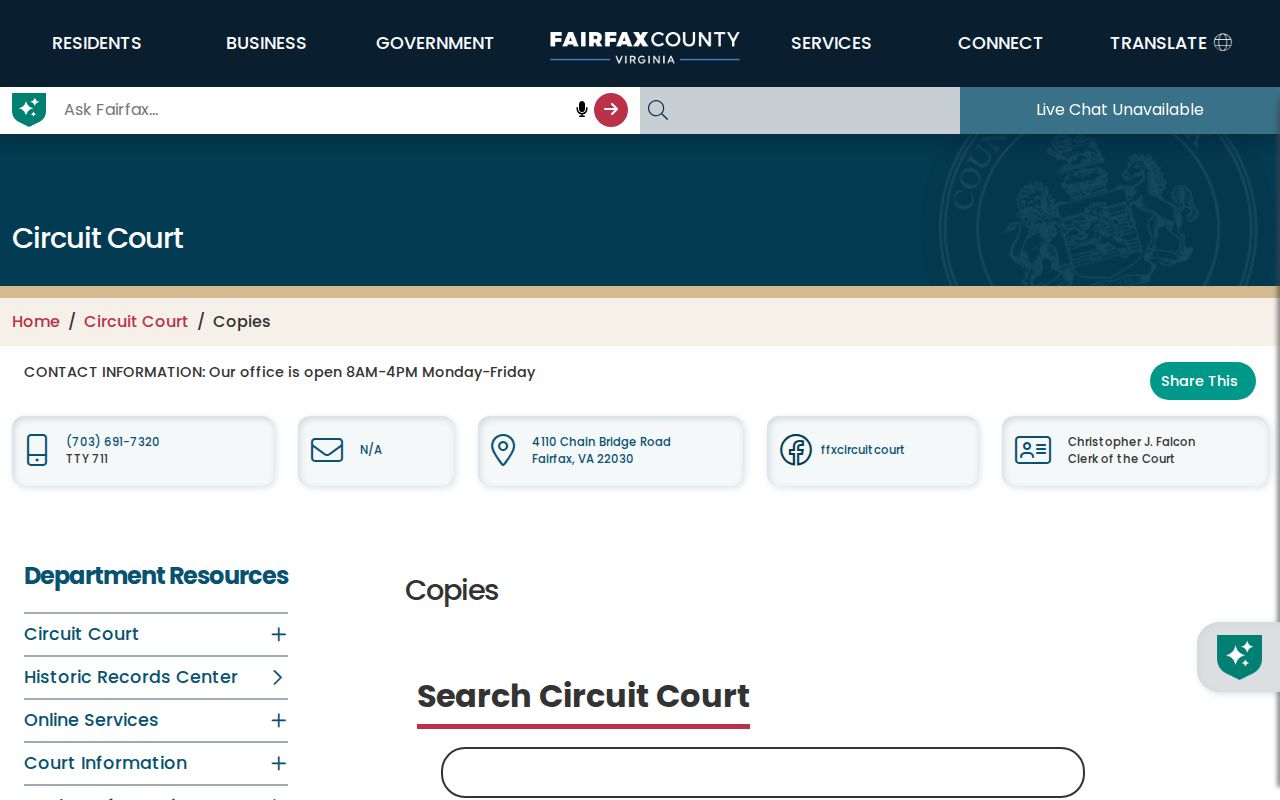
That copy route is useful after the deed chain has produced a precise instrument or book-page reference.
McLean Past Residents in Early Books
Fairfax's broad land-record collection reaches back to 1742, but the access method changes with the book. Original Liber deed books from 1742 through 1942 are held through the Historic Records Center; CPAN and the third-floor access route cover indexes after 1866. Older work may require an appointment, archivist retrieval, and notes from a fragile volume. The Historic Records Center can be reached at 703-246-4168 or CCRHistoricRecords@fairfaxcounty.gov.
Record gaps matter. Fairfax identifies missing number-one books F, H, J, N, and V, plus number-two books C, D, F, H, I, K, N, Q, and T. The Library of Virginia's Fairfax microfilm catalog also describes substantial loss across the Civil War period and missing deed books in 1763-1819. A missing book does not end the search. Tax books, a successor deed, a plat, chancery material, or a newspaper notice may preserve a link that the missing volume cannot.
McLean Previous Residents in Directories
Deeds identify a transfer, not every person who lived at the address. The Fairfax directory collection lists local runs for 1877, 1878, 1880, 1884, 1888, 1890, 1897, 1906, and 1911. Search the surname first, then ask the Virginia Room about an address-first telephone or criss-cross volume if it is needed. Preserve the printed spelling, initials, abbreviation marks, volume year, and page. The historical volumes themselves are described in the McLean City Directories collection page.
- Choose the listed directory year closest to the transfer or household date already documented.
- Search surname variants, initials, spouse notation, and the historical street spelling rather than relying on a modern address alone.
- Pair the directory clue with the nearest public federal census, which provides household relationships, ages, and occupations after the 72-year release.
- Test a change with the Virginia Room newspaper index, then use a probate or deed record for the legal connection.
The Virginia Room offers microform equipment, local-history staff, directory and telephone-book holdings, and a CPAN terminal. Its newspaper index can be searched with a surname or initials; some results lead to microfilm, while Fairfax News results may be digitized. Email research requests to va_room@fairfaxcounty.gov, and the documented copy charge is $0.50 per page.
McLean Past Residents and House Maps
Fairfax property-history guidelines recommend a tax-map reference, deeds and plats, older tax maps, G.M. Hopkins maps, the Virginia Room, and WPA historical-inventory resources. Fairfax aerial imagery reaches back to 1937 and Digital Map Viewer property maps are available annually from 1960. These sources can test whether the road, parcel pattern, or building footprint changed. They cannot establish that a particular person occupied the structure.
Land-development records add a separate time layer. Records before the October 31, 2022 PLUS launch may be in LDIH or older history, while later material is in PLUS. If a permit search fails, try the legacy system and then the county's FOIA route. Do not turn a current improvement value or a map image into a claimed construction date without a record that actually supports it.
The county's property-history research guide sets out the local sequence from tax map to deed, plat, map, and library evidence.
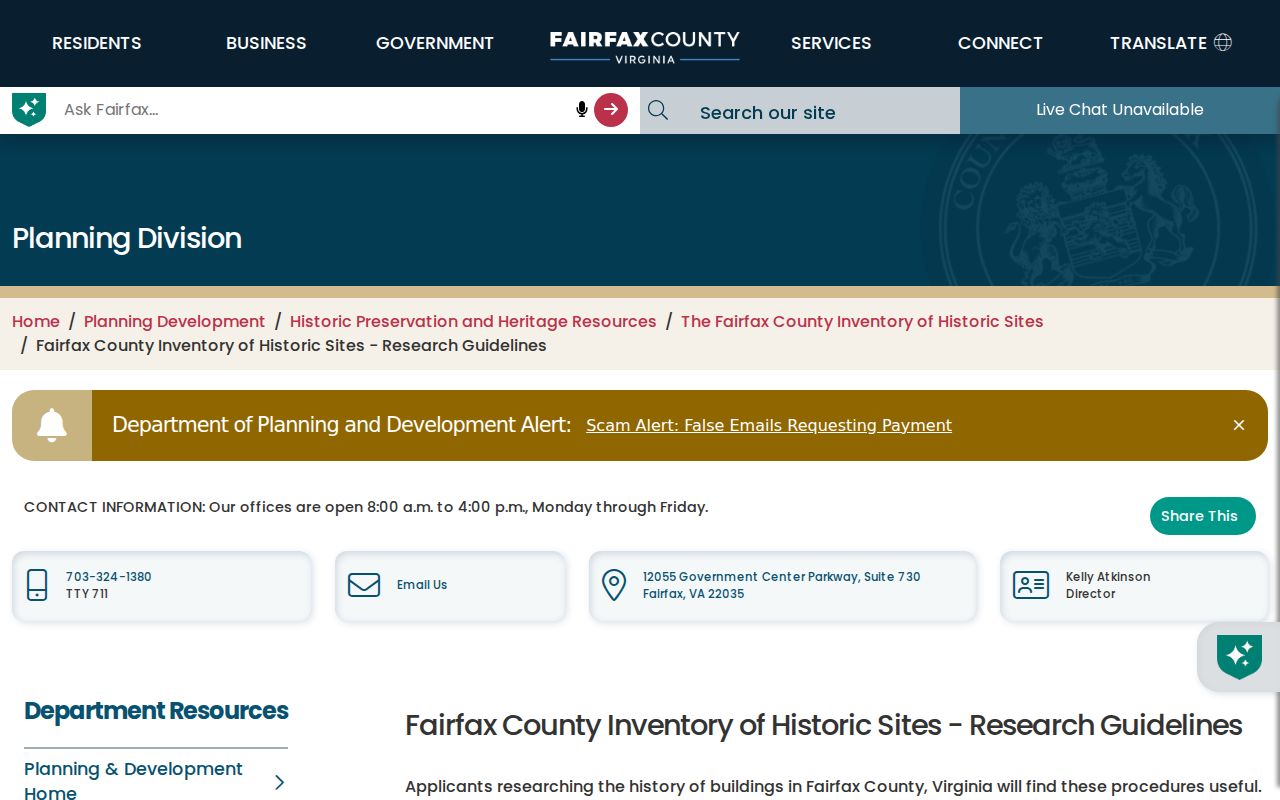
Use the guide to place maps and permits alongside the deed and directory dates, not in place of them.
McLean Previous Residents at Probate
An obituary or probate file can close a past-residents trail when a directory name disappears or ownership moves through an estate. Fairfax probate and estate administration appear among CPAN modules, while the Historic Records Center holds original wills from 1742 to 1935. A death notice may connect a directory resident to a spouse, executor, or heir. It does not prove that every named relative lived at the McLean address, so compare the notice with the deed, parcel, and dated directory entry.
For recent vital records, Virginia's access rules matter. Under Virginia Code §32.1-271, birth records become public after 100 years and death, marriage, divorce, and annulment records after 25 years. Recent certified copies are limited by statute. The Virginia Department of Health is the proper route for an eligible certificate, while Fairfax Circuit Court holds court divorce files.
McLean Past Residents Before Addresses
Before a modern street number existed, Fairfax land-tax books can carry the owner trail. The Historic Records Center's 1851-1980 land-tax series records the owner, acreage, distance and direction from the courthouse, value per acre with and without buildings, and assessed taxes. Library of Virginia microfilm extends the tax-book route back into earlier years. Personal-property tax books, held for 1851-1939, may add household context but are fragile and may not be copyable.
The Fairfax 1860 property-owner map project can bridge a modern parcel to a historical owner and acreage, then point toward deed-book, will-book, or chancery references. Use it as a map-key bridge. It is not proof that a modern address occupied the same physical footprint.
McLean Previous Residents and Gaps
Address continuity is the main trap in a McLean house history. Rural-route language, a changed street name, a new subdivision, parcel splits, and differing ZIP or CDP labels can make the right predecessor invisible in a simple address search. No verified McLean-wide renumbering year was located. Bridge the change with the tax map, plat, road-name history, neighboring parcel lines, and deed legal description rather than assuming a failed address query means no earlier resident existed.
McLean is an unincorporated Fairfax County CDP, so county records are the controlling local route. Keep the public-record vocabulary precise: an estate, trustee, guardian, or corporation can appear as an owner; a seller can be a prior recorded party without being a household member. Those distinctions make the result useful for an heir, family, or property-history question without overstating what the records prove.
Note: Preserve a separate reason for each no-result, such as a protected record, missing book, non-indexed volume, wrong suffix, or unresolved parcel split.