
McLean City Directories on Fairfax Shelves
McLean is an unincorporated Census CDP, so its historical paper trail is largely kept in Fairfax and Northern Virginia repositories rather than by a McLean city clerk. The Virginia Room brings together local history, genealogy, directories, telephone books, newspapers, maps, manuscripts, photographs, rare books, and yearbooks. Its collection is the practical starting point for a McLean household, even when a volume is labeled Fairfax County or uses a postal locality rather than the CDP name.
| Collection | Years represented | Where held | How to use it |
|---|---|---|---|
| Fairfax County directories | 1877, 1878, 1880, 1884, 1888, 1890, 1897, 1906, 1911 | Fairfax County directory collection | Local directory years and transcription route |
| Telephone books | Exact McLean and Fairfax runs need staff confirmation | Virginia Room | Household, business, or possible address sequence |
| School yearbooks | More than 300 digitized volumes; nearly 500 physical volumes | Fairfax County Public Library and Internet Archive | Names, class groups, activities, portraits, and school context |
| Fairfax newspaper index | Title-specific runs, including Fairfax Herald 1886-1973 | Virginia Room index and microfilm | Obituaries, notices, civic events, and property names |
| Rambler Washington Star | 1912-1928 | Virginia Room newspaper index | Transcribed Fairfax people and place subjects |
Fairfax County directory years are intermittent, not a promise of an annual series. The available official capture did not identify every publisher, shelf number, reverse-volume run, or final printed issue. Record the edition year and page before moving to another source. That small citation makes a later check possible when a spelling, street name, or household mark turns out to matter.
Fairfax County's city-directory collection lists the local directory years and provides the local-history route used for McLean research.
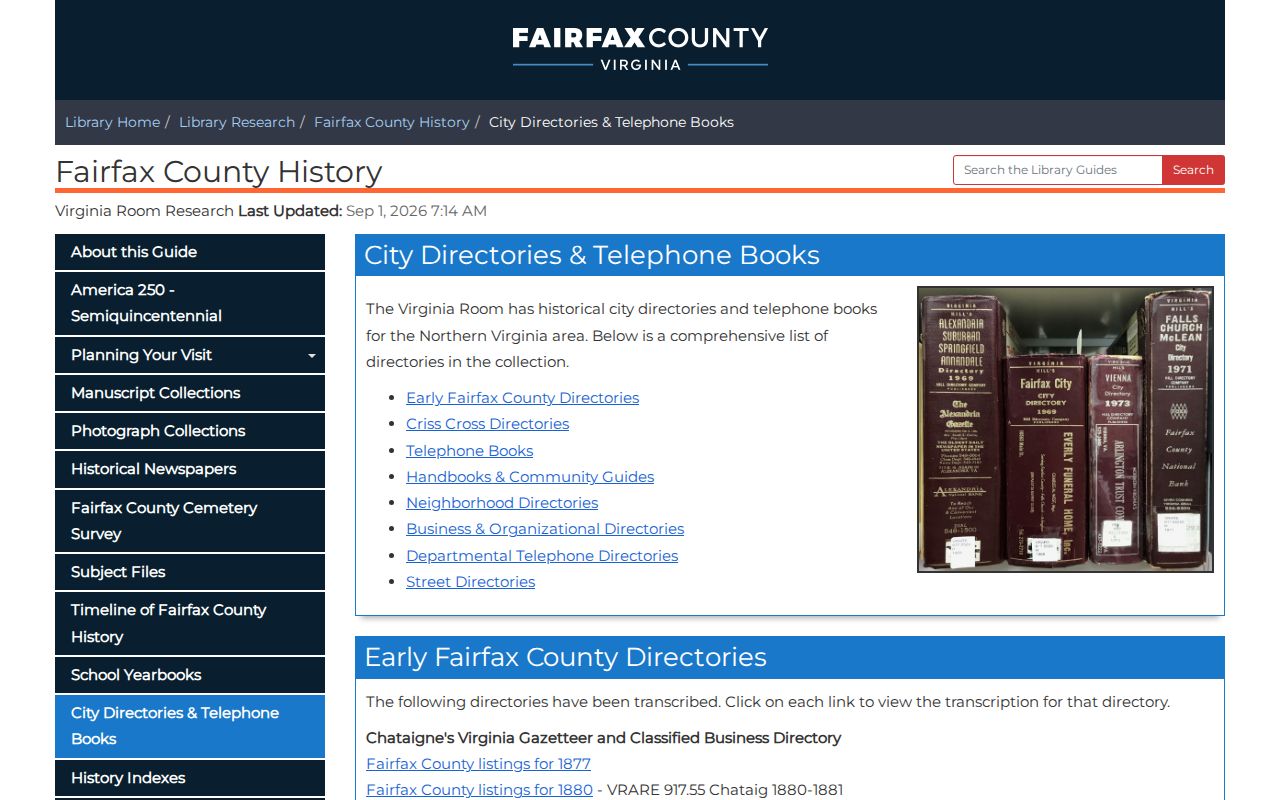
The collection page is a locator, not proof that every volume is fully searchable from home. When a needed page is not online, ask the Virginia Room for the exact title, year, call number, and whether it is alphabetical, telephone, reverse, or a subject index.
Why McLean Uses Fairfax Directory Records
A directory label can be misleading if it is read as a municipal boundary. McLean has no incorporated city government or city court. Fairfax County functions, the Dranesville District, and postal naming explain why a useful record may be filed under Fairfax rather than McLean. Use the printed address and volume year as the main local keys, then check the parcel or road history when the locality name changes across sources.
The McLean Community Center has public civic and board records, but it is not a resident roster. Its value is a trail for civic-history questions. The Fairfax County Board's Dranesville context also helps distinguish McLean from Great Falls, Herndon, and nearby places when a directory's abbreviated locality label is broad.
Note: A postal locality, neighborhood name, or county-wide directory market does not establish that McLean was legally incorporated.
Read a McLean City Directory Entry
A directory entry is usually a compact finding aid. Start with the surname in alphabetical order, then capture the printed form exactly. The local collection did not expose a scanned McLean example in the available official capture, so no sample line should be invented. Still, the standard entry pattern and the Fairfax collection description identify the fields worth recording before the book is put away.
| Entry part | What to record |
|---|---|
| Name | Surname, given name, initials, and every punctuation or spelling variant |
| Address | Street, number, unit or locality wording, plus the volume year and page |
| Household clue | Possible spouse, widow, business, or householder notation when printed |
| Occupation or business | A time-specific affiliation clue, not a residence finding by itself |
| Abbreviations | The volume's own key, copied with the entry rather than guessed |
- Criss-cross directory
- An address-first volume that may help locate the name printed at a known street address.
- Householder index
- A list organized around the named head or responsible household entry, not necessarily every person at the address.
- Abbreviation key
- The publisher's explanation for shortened marks. Its meaning can vary by volume and year.
Do not turn a notation into more than it says. A business address may differ from a household address, and a head-of-household entry does not prove who else lived there. When a historic entry needs a modern address-keyed record, use the county tools summarized on the McLean by-street directory page instead of treating an old printed line as current evidence.
McLean Directory Years Have Real Gaps
The listed Fairfax directory dates begin with 1877 and continue through selected years to 1911. They should be treated as points on a timeline, not a complete chain. The Library of Congress describes city directories as irregular local publications whose coverage varies by place and edition. A missing name can reflect an omitted year, a different locality label, an unsearched reverse volume, a boarder not named as householder, or a change in the publisher's practice.
- Write down the last confirmed directory year, page, spelling, and street form.
- Check the nearest listed Fairfax volume on either side, without assuming that every intervening year exists.
- Search the surname, initials, spouse notation, business name, and an address sequence if a reverse source is available.
- Test any apparent move with a newspaper notice, map, deed, probate record, or census image.
Fairfax record history adds another reason to mark gaps plainly. Civil War destruction affected original wills, deeds, loose papers, and many deed books from 1763 through 1819. Later sources such as tax books, successor deeds, maps, newspapers, court order books, microfilm, and family directories can sometimes rebuild part of a trail, but they do not erase the missing source.
Trace a McLean Household Through Directories
Household tracing works best when the directory year is paired with a record that was made for a different purpose. Begin with a known address or surname, but keep a separate line for each spelling and each person with the same name. The aim is not to build one sweeping profile. It is to test whether the address, relationship clue, age, business name, parcel, or dated event supports the same historical household.
- Find the nearest directory year and copy the name, address, page, abbreviations, and any spouse or business wording.
- Search the address or street in a reverse, criss-cross, or telephone volume if the Virginia Room confirms one is available.
- Pair that year with the nearest released federal census. Census geography can differ from the modern CDP or ZIP, so use the enumeration district and street description.
- Use a marriage, death, probate notice, deed, or newspaper item to test a move, relationship, or name change.
- Keep uncertainty visible when only one identifier agrees, especially for common surnames and initials.
The 1950 census is the most recent fully released decennial census in the research record, under the 72-year release rule. A directory can name a head of household while the census may name more people. Neither source alone settles the identity question.
McLean Newspaper Clues Test a Directory Move
The Virginia Room's historical-newspaper index is a useful second check after a name or street appears in a directory. It accepts at least one search term, allows three search boxes joined by AND, and offers a surname-friendly “beginning of subject only” option. Search the surname first, then try initials and the form printed in the directory. Preserve the newspaper title, date, page, column, and whether the result is an image or only an index reference.
The Fairfax historical-newspaper index directs researchers to title-specific coverage and the Virginia Room microfilm route.
Some hits point to microfilm rather than a web image. Fairfax News may provide a digitized PDF, while Rambler Washington Star results are transcribed. For copies or a local-history question, the Virginia Room accepts research requests at va_room@fairfaxcounty.gov and reports copies at $0.50 per page.
Virginia Room Help for McLean Directories
The Virginia Room at City of Fairfax Regional Library is the specialist stop for an item that cannot be resolved online. It is at 10360 North Street, Fairfax, VA 22030, and can be reached at 703-293-6227, option 6, or va_room@fairfaxcounty.gov. The collection includes local history, genealogy, maps, photographs, manuscripts, newspapers, rare books, yearbooks, directories, and legal and government materials. Its equipment includes microform reader-printers that can save to USB, internet stations, Memory Depot stations, and a designated CPAN station. Dolley Madison Library, 1244 Oak Ridge Avenue in McLean, is the neighborhood branch and referral point.
Fairfax County's Virginia Room page identifies the local-history branch that holds the directory, newspaper, map, and yearbook research tools used for McLean searches.
The best request is specific: give staff a person or address, a date range, and the type of volume sought. Ask whether the title is alphabetical, reverse, telephone, or subject-only, and whether it is on a shelf, microform, or a separate local-history file. That avoids claiming a continuous McLean run where the available catalog capture does not prove one.
Maps Give McLean Directories a Place
Directories give a dated address clue. Maps and land records help connect that clue to a parcel or an older road description. Fairfax's house-history route points to tax-map references, deed books and plats, older tax maps, G. M. Hopkins maps, Sanborn maps for towns and cities, Virginia Room sources, and WPA Virginia Historical Inventory material. No McLean-specific Sanborn title or year coverage was confirmed in the research, so a particular McLean street should not be claimed without a map check.
The Fairfax 1860 map project is especially useful when the period fits: its maps can show parcel owner, acreage, deed book and page, will book and page, and chancery-file numbers. The Historic Records Center holds originals, while the Virginia Room has a map book and the “Collective Biography” volume. Use a map as a bridge between a directory's street wording and a legal-description trail, not as a substitute for either record.
McLean Directory Myth: One Book Proves Residence
A single line does not prove that a person remained at an address for an entire year, owned the place, or was the only household member. It is a dated publication entry. The same caution applies to a name that is absent: the Fairfax series is not annual, and the available official collection capture leaves some telephone and reverse-directory runs unconfirmed. Treat the entry as evidence to compare, not as a final answer.
For a fuller historical trail, combine a directory year with census, newspaper, probate, deed, or map evidence. That approach respects the gaps in Fairfax records while preserving the detail that a small printed entry can still provide.